
Financial leaders feeling anxious, a lavish cash room and Washington pointing fingers at China - my week with world finance elite

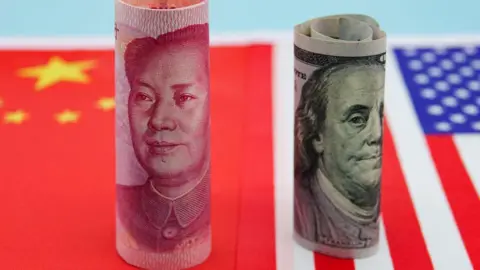
One finds an eerie emptiness at the center of United States economic power.
America's Treasury has closed down similar to much of the national government.
Nearly all workers are furloughed as global treasury officials and financial executives fly in for the International Monetary Fund regular conferences nearby, their delayed flights managed by a handful of unpaid aviation directors.
Definite Statement coming from American leadership
There is, nonetheless, an unambiguous communication American officials are particularly eager to communicate, not primarily for its domestic audience but for the confused world outside.
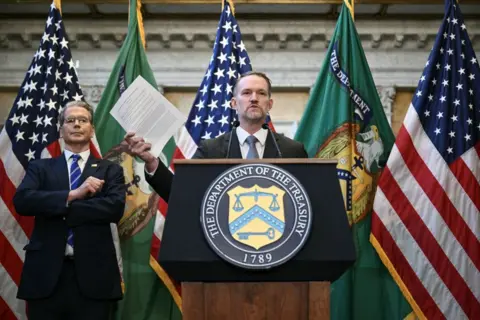
And they delivered it in the middle of recent days to a limited group of attendees escorted into the financial department and allegedly the most impressive chamber in America's political center, the ornate and polished Financial Chamber, which accommodated the inaugural reception for post-civil war president, Ulysses Grant.
Understand clearly, stated Financial Chief Scott Bessent accompanied by Business Diplomat Jamieson Greer, as they initiated the latest salvo in the current 2025 global trade war. It represents China versus global community.
This simple message links several remarkable monetary developments circulating throughout the world right now.
International Financial Currents
They include Beijing's recent trade restrictions on vital materials, concerns of a technology bubble collapsing, the trade levy disorder and even the production of an erotic chatbot by the AI company.
The global community consistently appears to move a little in its direction during the fortnight each year that top bankers and finance ministers mass in America's political center for their discussions at the IMF.
It's unusual that the host itself is the principal origin of turmoil. Usually it could be a growing nation, or perhaps EU members in the 2010s and notoriously the United Kingdom in 2022.
The choices and uncertainty arising from Washington's economic approach, confusing financial systems and choices over monetary policy, seem important.
Beijing's Trade Controls
The inevitable communication being sent by the top two US trade negotiators as they communicated with a small group of journalists in the Treasury's Cash Room was that China last week initiated possibly its most potent weapon to date by significantly expanding limitations on the trade of rare earth components.
These represent essential to the manufacturing of advanced technology products including EVs to defense equipment.
The financial official called this action a "China grip" on the globe.
Chinese "comprehensive extension" of commerce limitations on essential minerals and equipment, as well as electric vehicle battery tech, industrial diamonds and extremely durable substances is "an implementation in economic coercion on each state in the international community", said the Trade Ambassador.
Worldwide Business Interactions
This allegation is being leveled as his superior, the US President tries to redraw global trade relations by applying levies to eradicate American commerce imbalances.
He could have produced what is the strictest levy framework the international community has experienced in decades but the disturbance it has generated has been surprisingly muted until now.
The biggest economy globally is now behind a considerable tariff wall but it hasn't yet feel the impact, partially thanks to a wealth boom based on quite inflated technology assessments.
Financial Shielding
Enterprises selling to the US have swallowed the price of tariffs, which are effectively border duties, in their earnings. But is that merely for the time being?
The protection of tariffs that Washington has established protecting its market has resulted in increased commerce, such as, from Beijing to European nations and African countries.
Washington itself has been shielded, at present, from the significant ambiguities, increased costs and domestic living standards consequences of the levies and the 10% decrease in the value of American money.
Certain shielding has resulted from thriving technology field stock prices, creating a profound wealth effect in particular homes throughout America, determined by the financial institution financial experts as worth $180 billion per year.
Digital Valuation Fears
The narrow boundary between expansion and overvaluation is challenging to calculate. At times, it becomes apparent.
I was standing close to the technology exchange in New York's Times Square, where the digital trading platform which represents US private sector tech ascendancy publicises its latest IPOs to the international community.
Among the many of investment groups which raises real cash to plough into cryptocurrency, enthusiastically "started the session", even though their stock value {already having